
Autoware Foundation releases Autoware 2.0 to Expand AI Support for Open-Source Autonomous Driving
New planning architecture, End-to-End AI models, package discovery tools and Reference Design framework give developers more flexibility to build and evaluate autonomous driving systems.
November 2, 2026 — The Autoware Foundation (AWF) today released Autoware 2.0, adding support for end-to-end (E2E) AI and hybrid driving stacks next to the rule-based modules. The release also introduces new ways for managing AI models and composing complete systems.
Autoware has been traditionally structured as a modular pipeline for sensing, perception, localization, planning, and control. Its packages are organized into two layers: Autoware Core, a curated set of stable, well-tested libraries, APIs, and interfaces maintained by the Foundation; Autoware Universe, which extends Core with additional features, experimental algorithms, and community contributions, allowing new capabilities to be shared with users quickly. Autoware 2.0 builds on this architecture rather than replacing it.
The release brings rule-based and AI-based technologies into a shared architecture, allowing developers to compare and combine them for different applications. It also introduces Autoware Index, a registry for discovering compatible packages, and the Autoware Reference Design framework, which helps developers move from open-source components to a complete autonomous driving system.
Why Autoware 2.0?
As autonomous driving development advances toward learned and end-to-end (E2E) approaches, developers need ways to evaluate new AI capabilities alongside established robotics software. Autoware 2.0 supports this work while preserving access to the transparency and predictability of rule-based planning.
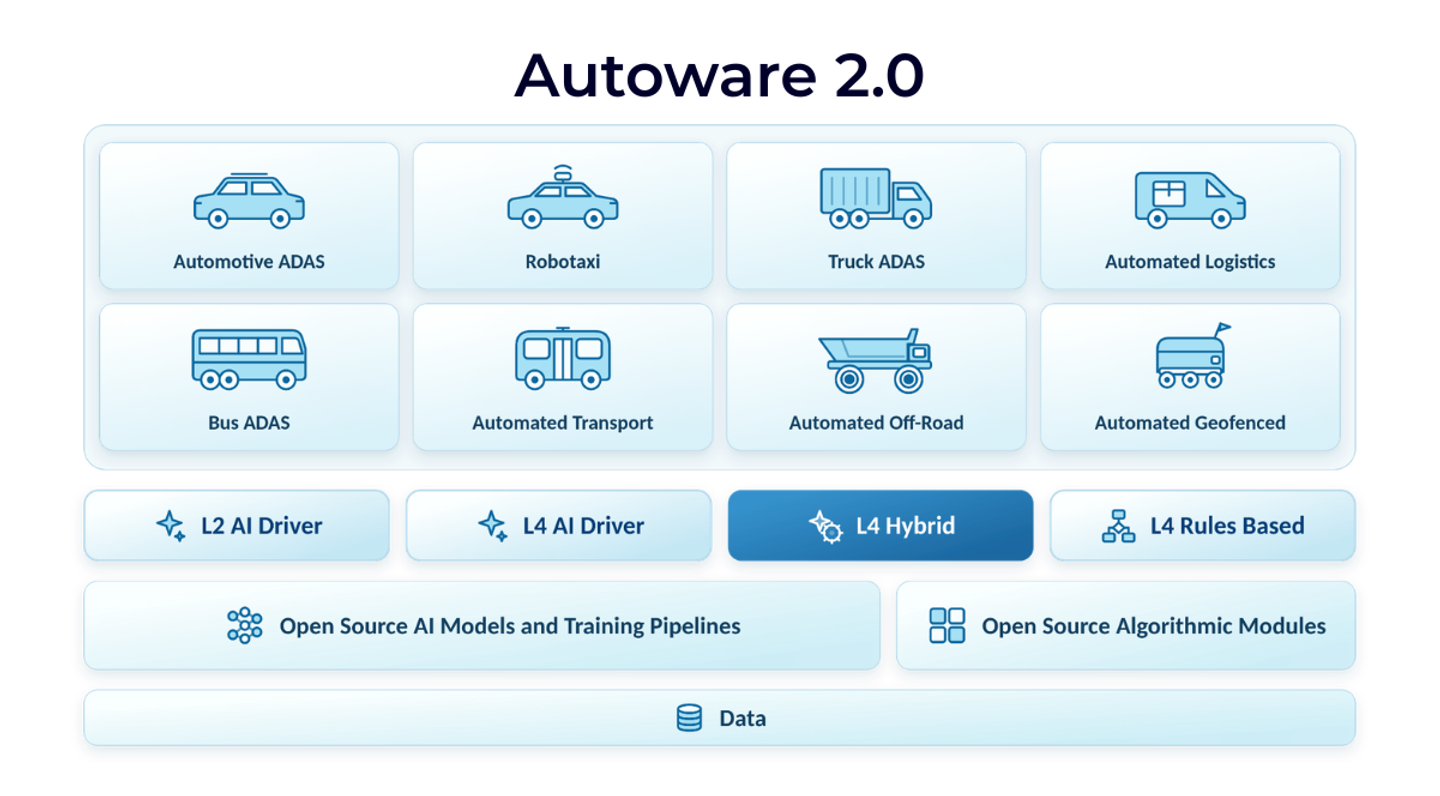
Highlights of the Autoware 2.0 Release
1. End-to-End (E2E) support with a selectable planner architecture
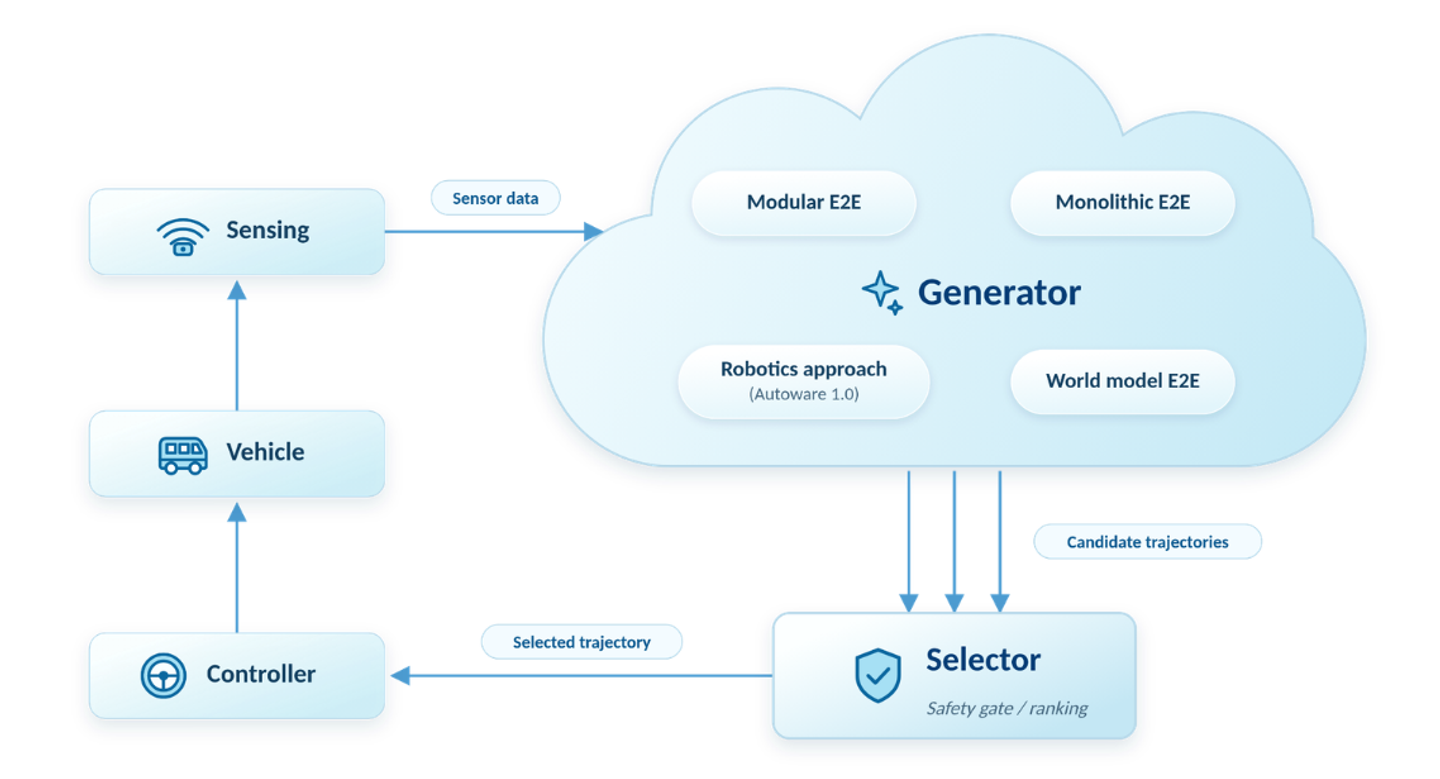
A new generator–selector architecture allows multiple trajectory generators to run within the same system, with a selector choosing which output to use. Developers can use rule-based modules, AI modules and a hybrid combination of modules to compose a single architecture for their use case.
The release includes:
- Documentation of the new generator–selector architecture
- Simulator demonstration with rule-based modules and various E2E modules.
2. Per-package AI model management, with Hugging Face as the default home
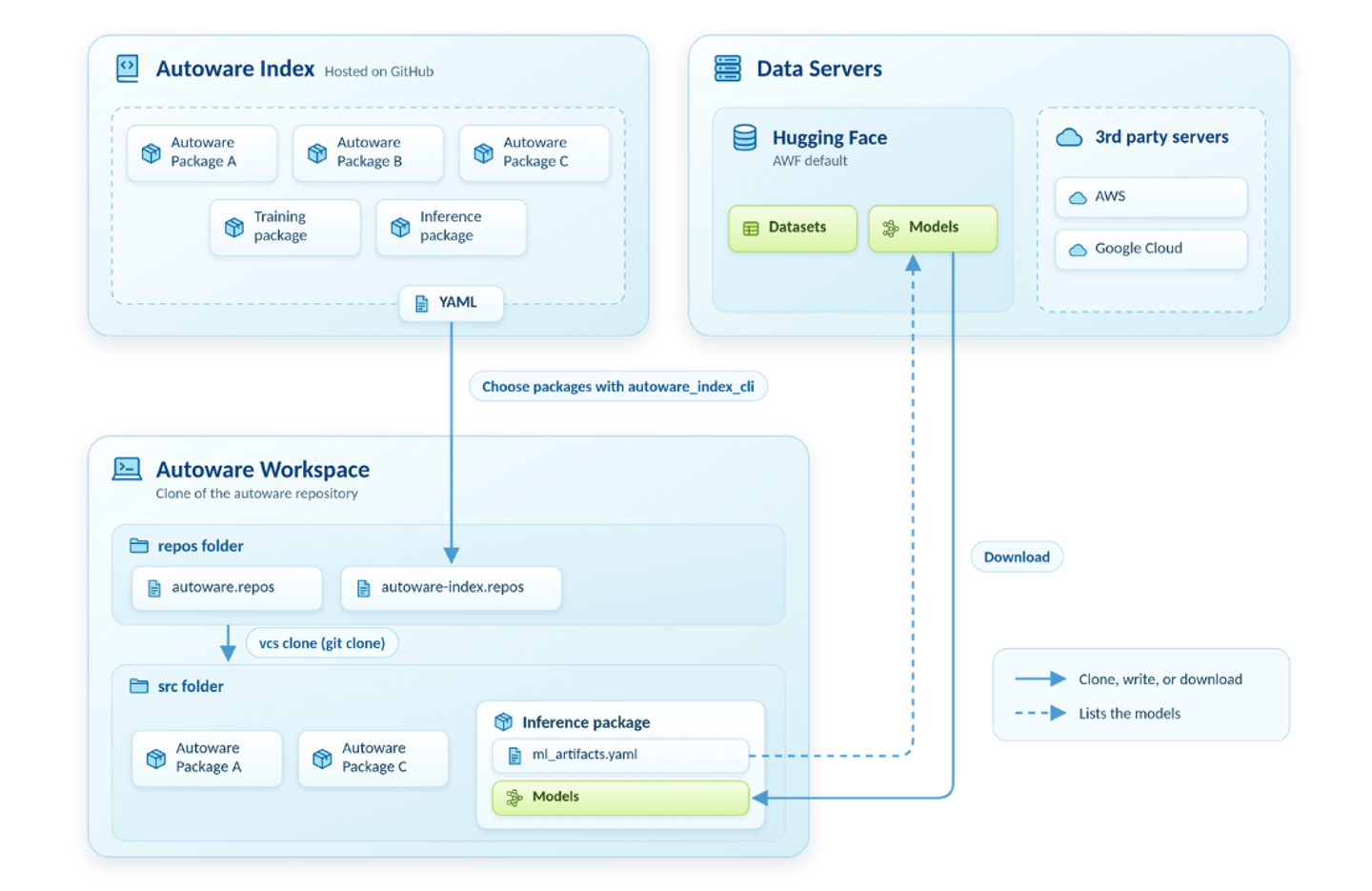
Autoware 2.0 changes how AI models and datasets reach a workspace. Until now, every model download was defined in one central Ansible file. The AWF organization on Hugging Face now becomes the default home for Autoware Foundation models and datasets, with version control. Manifests can also point to the AWF ML server, AWS S3, or third-party servers, so existing artifacts keep working during the migration.
3. Autoware Index: discover packages and compose custom workspaces
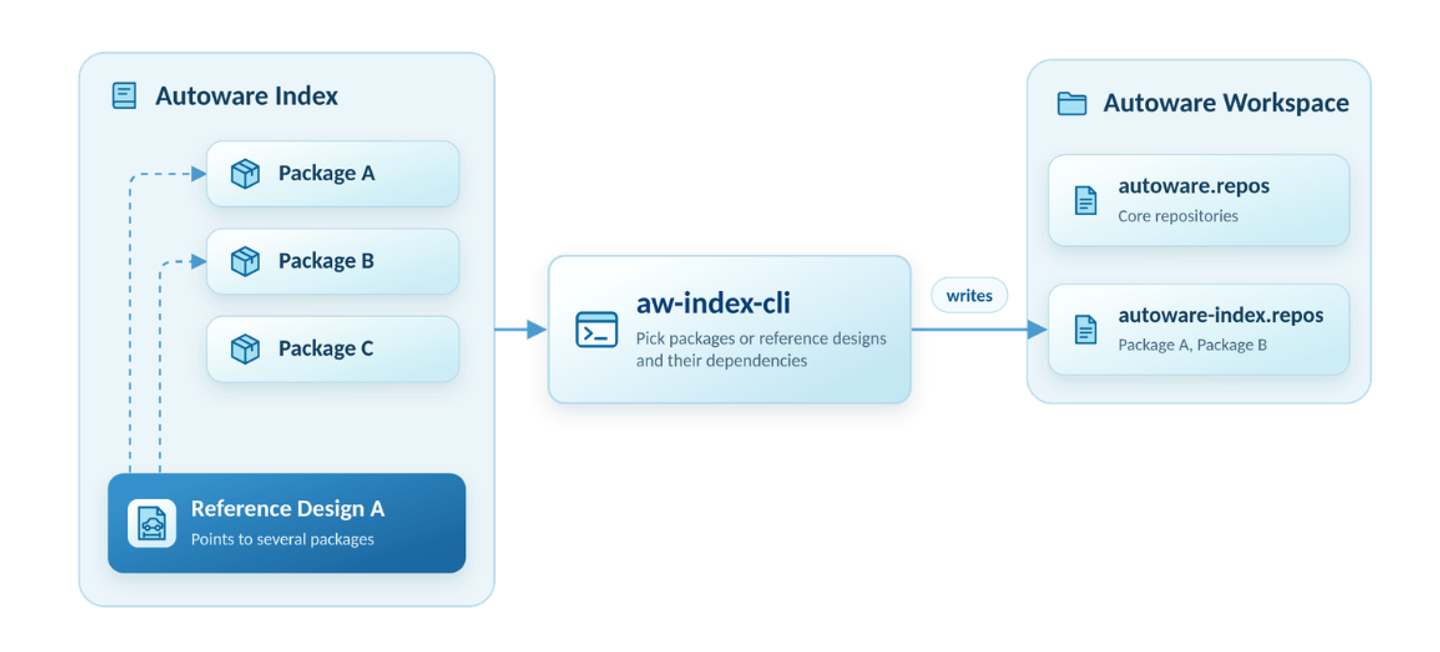
The new Autoware Index is a collection of links to Autoware-compatible repositories and Reference Designs. Community members can register their packages, and users can discover them in one place. It is also linked from the Autoware Documentation.
With the new Autoware Index CLI, developers compose their own Autoware workspace. The Autoware repository still comes with the core repositories (autoware.repos). The CLI lets users pick packages, or a whole Reference Design, together with their dependencies, and writes them to an autoware-index.repos file in the workspace. A Reference Design in the Index points to all the packages it needs, so one choice brings in a complete system configuration.
With this release:
- Five Universe packages moved to their own repositories in the Autoware Index.
- E2E packages registered in Autoware Index.
- Tags are reorganized so that users can find packages easily, for example “ai”, “reference-design”, and “e2e”.
- The Index lists AI inference packages, with their models on Hugging Face.
Autoware Index enables the ecosystem to grow beyond a single repository. Contributors retain ownership of their packages, while users gain a central place to discover them and a command-line to build a workspace.
4. Introducing Autoware Reference Design
Autoware provides software components for perception, localization, planning, and control. Building a complete autonomous vehicle also requires decisions about the vehicle, sensors, compute, operating conditions, and testing. The new Autoware Reference Design framework brings these elements together into a practical system-level blueprint.
Deployment Profile + Reference Software Stack = Reference Design
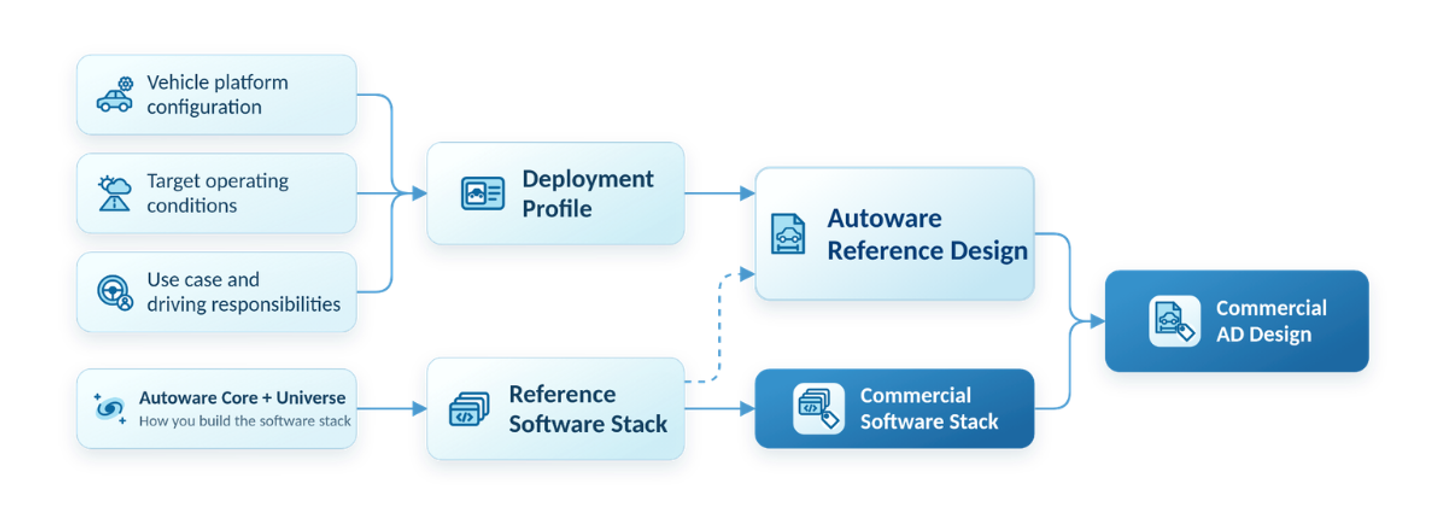
- Deployment Profile — the platform and operating target. It describes the vehicle and hardware configuration, the operating conditions, and the use case.
- Reference Software Stack — a software configuration that Autoware publishes and maintains as a recommended baseline. A stack name resolves to a concrete set of modules, model versions, parameters, interfaces, and platform requirements. Candidate stacks include Rule-based Planning, E2E stack, and Hybrid stack.
- Reference Design — a documented, versioned combination of the two. It records purpose, operating domain, platform, software, integration, and evaluation, so that the system can be reproduced and assessed.
Profiles and stacks are reusable. One software stack can serve several deployment profiles, and one profile can be evaluated with different stacks.
Reference Designs are grouped into application families, such as low-speed shuttles, highway assistance, and urban robotaxis. Each design has a baseline and documented variants. For example, a campus shuttle design can use rule-based planning, an E2E planner, or a hybrid configuration with the same deployment profile.
The first proposed Reference Designs are:
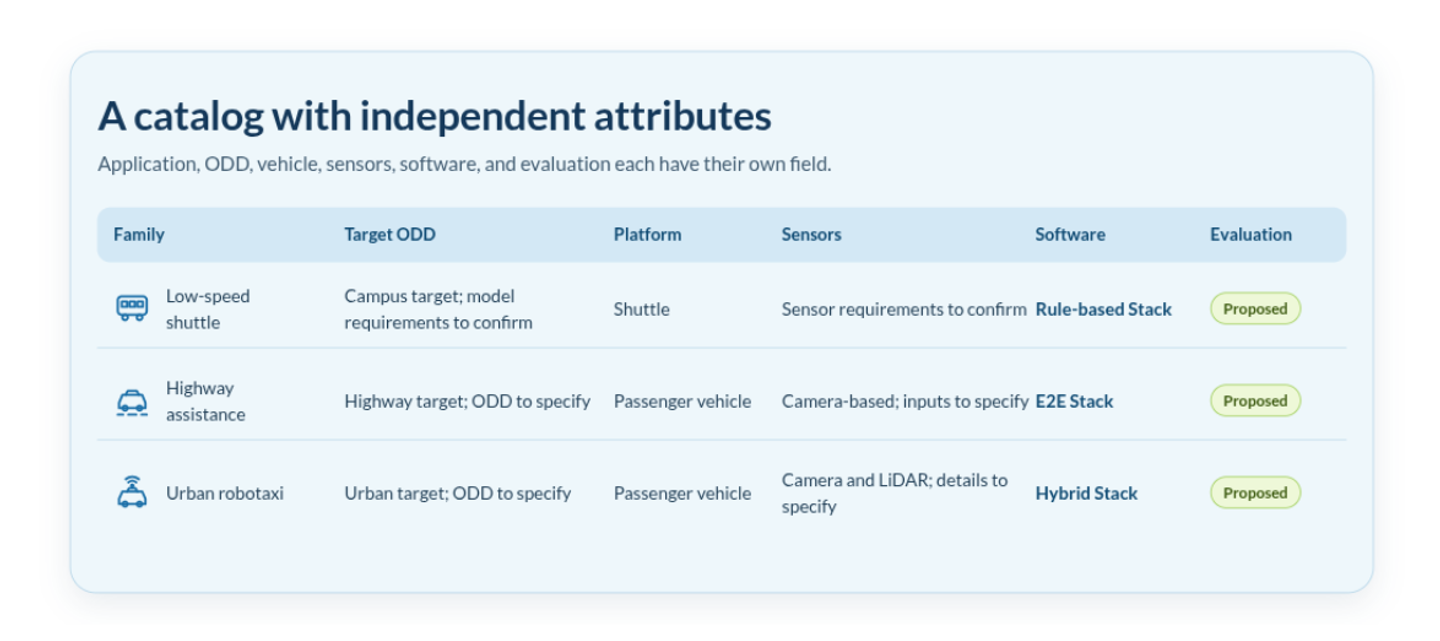
Operating domains are described using ASAM OpenODD terminology. Reference Designs provide recommended architecture and implementation patterns that companies and researchers can adapt to their vehicles, budgets, operational design domains (ODDs), and requirements. Commercial partners can build their own software stacks and autonomous driving designs on top of their framework. Each design also states its status, clearly distinguishing intended capability from demonstrated results.
Community perspective
Muhammad Zain Khawaja, President, The Autoware Foundation
Autoware 2.0 brings AI technologies into the heart of the Autoware open source autonomy stack, enabling developers to seamlessly transition from rule-based robotics modules towards End-to-End AI and hybrid autonomy stacks. We’re excited to announce the release of Autoware 2.0 and look forward to seeing our global community and ecosystem adopt the latest cutting-edge technologies for autonomy.
Ryohsuke Mitsudome, TSC Chair, The Autoware Foundation
Users often ask us how to go from Autoware’s software to a complete autonomous vehicle. Autoware 2.0 addresses this by introducing Autoware Reference Design with a documented blueprint for the entire system. Through the Autoware Index, community members can share their packages, and users can now set up a reference design with a single command.
Availability
Autoware 2.0 is available now at GitHub. Explore the documentation, discover community packages and Reference Designs through Autoware Index and access Autoware Foundation models on Hugging Face.
About Autoware Foundation
The Autoware Foundation is a non-profit organization dedicated to advancing open-source software for physical AI. By bringing together industry leaders, researchers, and developers, the Foundation fosters collaboration to accelerate the safe deployment of autonomous driving technologies worldwide.
Media Contact


